This week, I was a guest on The Season Pass Podcast for the third time. It was posted today and listening to it, I already found a couple of misstatements on my part:
Expo 2008 Zaragoza attendance:
I said that Expo 2008's final attendance figure was about 5.9 million, just shy of the 6 million they'd projected. I'm still researching the exact final attendance figures, but the attendance was closer to 5.5 million, still not too shabby for a 3-month exposition.
Barry Howard's United States Pavilion Experience:
I was right about his being involved in Expo 74 in Spokane and the 1984 Louisiana World Exposition, but his other United States Pavilion was Expo 70 in Osaka, Japan.
Showing posts with label Zaragoza. Show all posts
Showing posts with label Zaragoza. Show all posts


23 September 2008
Expo 2008, Aragon Pavilion
I've posted before about the wonderful Aragon Pavilion at Expo 2008, but this past week, I discovered that the pavilion's movie, Simfonía de Aragón, had posted online.
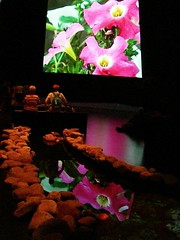
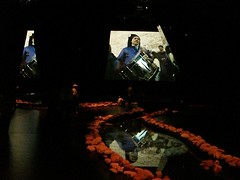
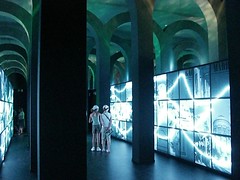
To put the film in context, it was shown on multiple screens in a huge room that took up an entire level of the pavilion. large glossy black irregular shapes, which served as support for the pavilion divided up the interior space, which was further articulated by little streams bordered by rocks. Visitors explored the space and navigated over the stream using small bridges and discovered a few hidden artifacts in recesses in the columns. In addition to the film that dominated the space, interactive projections also provided diversions on the floor.
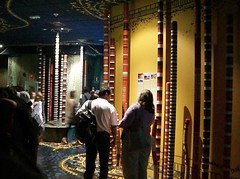
Here are three photos of the Aragon Paviion I took while there:
Here is the film in two parts:
To put the film in context, it was shown on multiple screens in a huge room that took up an entire level of the pavilion. large glossy black irregular shapes, which served as support for the pavilion divided up the interior space, which was further articulated by little streams bordered by rocks. Visitors explored the space and navigated over the stream using small bridges and discovered a few hidden artifacts in recesses in the columns. In addition to the film that dominated the space, interactive projections also provided diversions on the floor.
Here are three photos of the Aragon Paviion I took while there:
Here is the film in two parts:
20 September 2008
Expo 2008, Closing Day
Sadly, I was not at Expo 2008 for closing day. But, by all reports, it was pretty amazing. Thankfully, we live in the age of YouTube. A kind soul posted the closing ceremonies performance by Philip Glass (incidentally, my favorite composer), who also performed at Seville's Expo '92.
Expo 2008, being a relatively small world's fair, and Zaragoza, being a relatively small city, made for an amazing atmosphere. I can't recall a city being and an expo being so integrated into each other. The Expo seemed to start way outside the gates. The videos from the closing ceremonies show that. The fireworks running up and down the Ebro River connected the Expo site to the historic center of town. Like many visitors to Expo, my hotel was there, so I had the pleasure of walking to and from the world's fair site alongside the river.
Apparently, Expo 2008 had 5.65 million visitors, just shy of their projected 6 million. Interestingly, they overbuilt their parking facilities. They were mostly empty when I visited in June and apparently went mostly unused with 40.1% taking buses to the site and an amazing 18.5% traveling by foot! It's a wonderfully walkable city and I hope to visit someday in the future and see how the expo site is woven into the fabric of the city.
Here's Aragon TV's coverage (in 5 parts), including a great round-up video at the end:
Expo 2008, being a relatively small world's fair, and Zaragoza, being a relatively small city, made for an amazing atmosphere. I can't recall a city being and an expo being so integrated into each other. The Expo seemed to start way outside the gates. The videos from the closing ceremonies show that. The fireworks running up and down the Ebro River connected the Expo site to the historic center of town. Like many visitors to Expo, my hotel was there, so I had the pleasure of walking to and from the world's fair site alongside the river.
Apparently, Expo 2008 had 5.65 million visitors, just shy of their projected 6 million. Interestingly, they overbuilt their parking facilities. They were mostly empty when I visited in June and apparently went mostly unused with 40.1% taking buses to the site and an amazing 18.5% traveling by foot! It's a wonderfully walkable city and I hope to visit someday in the future and see how the expo site is woven into the fabric of the city.
Here's Aragon TV's coverage (in 5 parts), including a great round-up video at the end:
10 September 2008
Expo 2008 Attendance Numbers
I still haven't found a cumulative number for Expo 2008's attendance yet, but the BIE is reporting that the average attendance at Expo 2008 as of 09 September is 57,909. Not surprisingly, yesterday's attendance was higher than that: 89,441.
http://www.bie-paris.org/main/popup.php?a=620
I say it isn't surprising since we're in the last week. When I went to Expo 2005, I was there the last ten days and I can attest that there's always a huge surge of visitors during the last few days. People have unused tickets and many locals want to see the Expo before it closes. After all, there's no second season.
So, since yesterday was the 88th of the 93 days, we can assume they've had about 5,095,992 visitors (88 x 57,909). If we assume the next five days will also have high attendance (and I think we could argue the last two days, a weekend, will be even higher), that would add at least 447,205 more visitors (5 x 89,441) to make the total 5,543,197.
Before Expo 2008 started, they predicted 6,000,000 visitors. To meet that, they'd need 904,008 visitors in the next five days, an average of 180,801 per day.
http://www.bie-paris.org/main/popup.php?a=620
I say it isn't surprising since we're in the last week. When I went to Expo 2005, I was there the last ten days and I can attest that there's always a huge surge of visitors during the last few days. People have unused tickets and many locals want to see the Expo before it closes. After all, there's no second season.
So, since yesterday was the 88th of the 93 days, we can assume they've had about 5,095,992 visitors (88 x 57,909). If we assume the next five days will also have high attendance (and I think we could argue the last two days, a weekend, will be even higher), that would add at least 447,205 more visitors (5 x 89,441) to make the total 5,543,197.
Before Expo 2008 started, they predicted 6,000,000 visitors. To meet that, they'd need 904,008 visitors in the next five days, an average of 180,801 per day.
06 August 2008
Expo 2008 Review on Blooloop.com
Blooloop.com, an amusement/theme park industry web site, has just published an article I've written about Expo 2008.
10 July 2008
Expo 2008, Iceberg
Reading over my posts from my Expo 2008 visit and going through the 1200+ photos I took during those six days, I'm realizing there are noteworthy exhibits and performances I either didn't mention or didn't elaborate on.
The Iceberg performance is certainly one of these. The night before my first day on the site, we walked along the Ebro River toward the site and we were surprised by how much of Iceberg was visible from outside the gates. There was also a spectacular fireworks display afterwards.
I think this element of Expo 2008 will be one of the ones that folks in Zaragoza will remember decades from now when reminiscing about the expo. It's made even more powerful in that it is set on the opposite side of the river from the Expo site and the audience.
Unfortunately, my own video of Iceberg wasn't of a great quality. Lucky for us, others have posted on YouTube their own recordings. The best of these recordings I'm embedding here. It's in three parts.
The Iceberg performance is certainly one of these. The night before my first day on the site, we walked along the Ebro River toward the site and we were surprised by how much of Iceberg was visible from outside the gates. There was also a spectacular fireworks display afterwards.
I think this element of Expo 2008 will be one of the ones that folks in Zaragoza will remember decades from now when reminiscing about the expo. It's made even more powerful in that it is set on the opposite side of the river from the Expo site and the audience.
Unfortunately, my own video of Iceberg wasn't of a great quality. Lucky for us, others have posted on YouTube their own recordings. The best of these recordings I'm embedding here. It's in three parts.
30 June 2008
Expo 2008, Day 6
My final day of Expo I spent visiting my favorite pavilions and taking more photos and video.
I made sure to return to the Germany Pavilion and take this (rather poor quality) video of its ride:
I also captured this video outside the Japan Pavilion which shows the Expo 2008 mascot Fluvi with the Expo 2005 mascots Kiccoro and Morizzo:
I made sure to return to the Germany Pavilion and take this (rather poor quality) video of its ride:
I also captured this video outside the Japan Pavilion which shows the Expo 2008 mascot Fluvi with the Expo 2005 mascots Kiccoro and Morizzo:
28 June 2008
Expo 2008, Day 5
On my fifth day on the Expo 2008 site, I finally got a chance to see the Aragon Pavilion, the Spain Pavilion, and the Aquarium, meaning I finally saw every open pavilion.
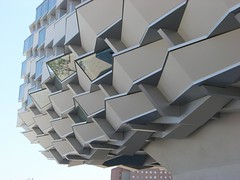
The Aragon Pavilion was designed to reference a fruit basket, one of the signature products of this region of Spain.
The exhibit ended in a large dark room with multiple screens showing the same images. It was an amazing experience to be in this space with other guests exploring the space that included pools of running water and a few artistic exhibits. My photos do not do the space justice, alas.
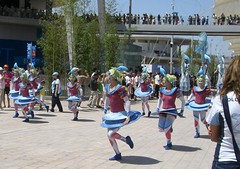
I finally got to see the parade through the grounds performed by Canada's Cirque du Soleil.
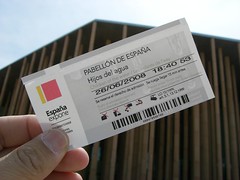
Spain's pavilion was, not surprisingly, difficult to get into.It starts with a domed Imax-style movie that was pretty amazing and continues through rather well designed exhibits. One room of exhibits was filled with those little plastic (blue) balls that you see in kids' play areas. There were signs advising guests to shuffle their feet to get through the area, but the exhibit area itself was roped off and we were detoured around it. I suspect it was a better idea in concept than in practice. I can imagine lots of people tripping and balls rolling into subsequent exhibit areas. Unfortunately, I was told not to photograph this exhibit, so I'll have to leave it to your imagination.
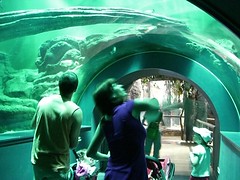
Expo 2008's aquarium is themed around the rivers of the world.
The Murray-Darling River section was particularly well themed and was a colorful reminder that you were looking at Australian wildlife.
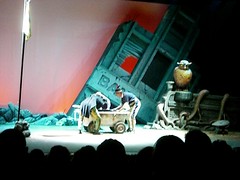
Many guests who don't speak Spanish may shy away from the performances, but I saw completely charmed by the Mondomono performance which relied mostly on visual humor to get its point across.
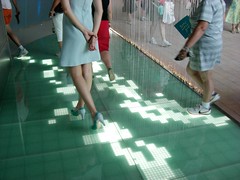
After finally seeing every exhibit, I took the time to revisit some of my favorite exhibits and take note of some of the details, such as this interactive floor in the Valencia Pavilion.
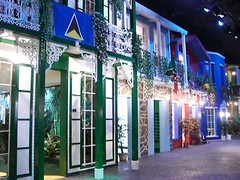
The Caribbean nations were grouped together in a wonderful space that brought what could have been conflicting exhibits into a cohesive, enjoyable space.
Madrid's small pavilion made clever use of mirrors to make their exhibit seem much larger than it really was.
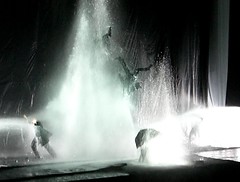
In the evening, I enjoyed the performance Hombre Vertiente.
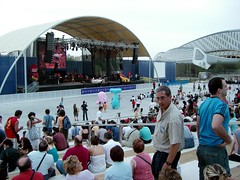
Expositions can be rather insular places where the outside world doesn't intercede much, but during the European Cup, it's difficult to ignore when the Russian Pavilion closes early so that employees can watch Spain play Russia broadcast in the Expo's amphitheatre. I noticed that Expo 2008's mascot Fluvi didn't take sides when presented a Spanish flag. After all, expos are a celebration of internationalism.
27 June 2008
Expo 2008, Day 4
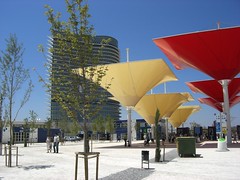
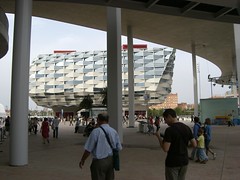
On Day 4, I finally got a chance to see the Tower of Water, the theme structure for Expo 2008. I have to admit that early on I had my reservations about this structure. It seemed like a rather large structure with such little content and at first glance, it looks like many office towers around the world. The main exception is that the outside horizontal lines are actually a slow spiral up and down the skin of the building.
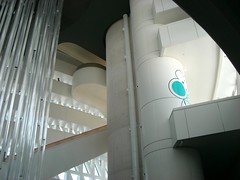
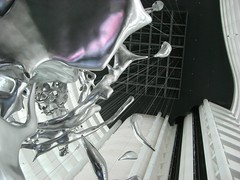
Visiting the tower, I'm afraid that my concerns were founded. With the exception of a few exhibits about water on the lowest level, the pavilion consists of two pieces of artwork that would make for a very impressive hotel lobby and lots of ramps.
Taking the escalator up a few stories, you see a rather amazing piece of artwork representing a splash of water.

Afterwards, however, you have a choice to go back down to the ground level through the (plain white) ramps just inside the skin of the building, which is tedious and takes several minutes... or you have this choice:
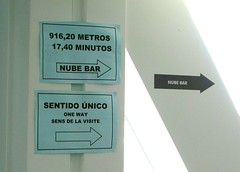
...which takes you to the upstairs Cloud (Nube) Bar... almost a kilometer walk up several stories of ramps. Elevators were reserved for the handicapped, so I chose the option to leave.
I have to wonder what amazing, iconic structure could have been built with the same resources. I think about the Eiffel Tower, the Trylon and Perisphere, and the Space Needle... all of which captured the public's imagination in the lead up to the exposition. I'm afraid this structure just seems too businesslike and unfriendly.
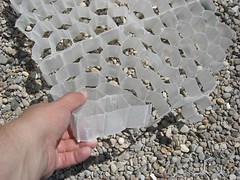
On the materials front, I have to make mention of an interesting material I saw being used with gravel. It gives you a surprisingly springy step despite walking on gravel and presumably, also keeps gravel from being kicked around the site.
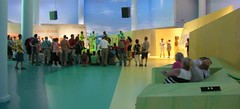
The exhibits by African countries in recent expositions have seemed a bit chaotic and claustrophobic as dozens of countries vie for attention in a limited space. This year, however, I'm happy to report an ingenious solution to the problem.
Countries are given more generous pacing and thick short walls separate the exhibits. It has the positive effect of both opening up the space and reducing visual clutter. It also means that turning every corner provides a potential visual surprise.
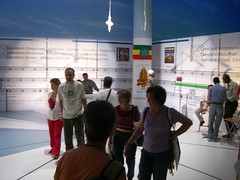
One such visual surprise was the Ethopian exhibit which celebrate the Ethiopian year 2000 (2008 in the Western Calendar) with a visual diagram of the year... radiating from the center of the exhibition space. Many pavilions suffer from repetitive panels with photos and text. I noticed that guests lingered far more in this space than other spaces with a more linear narrative.
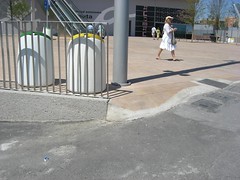
Expositions, naturally, have set dates and therefore suffer from a rush beforehand to finish everything by the opening date. I noticed a few areas where it was clear that some of the details hadn't quite been ironed out. It's a shame that some of these details weren't more artfully constructed.

The big surprise of my day was the Extreme Water ("Agua Extrema") Pavilion. It's always a joy to enter an exhibit not knowing what's inside and discover something fun and different. After visitors file past info-laden panels, they're given a rain ponch to wear for the theater presentation, a movie about heavy storms, hurricanes, and tsunamis that would leave you wet if not for the protective gear.
25 June 2008
Expo 2008, Day 3
On Day 3, I visited a few more national pavilions, the rest of the Spanish regional pavilions, and some of the theme pavilions.

I tried to visit the theme structure, the Water Tower (or Tower of Water), but unfortunately, it was closed for some reason. Unfortunately, my Spanish and the volunteers' English wasn't good enough to find out why. They suggested I try back later on. The tower was particularly striking at sunset, however.
To my eyes, though, I would have liked to have seen something a bit more iconic. The tower, from the outside at least, looks too much like many office towers I've seen.
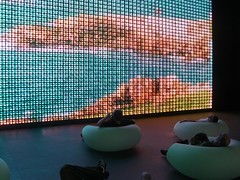
Galicia's pavilion was a good example of a small, simple pavilion that really works. There wasn't much to their exhibit as it was one where people simply wandered in and out, but the video installation was striking enough that I noticed many guests lingered for quite a while. It was more artistic and abstract that a simple video screen. Upon further inspection, I discovered each colored rectangle was actually the bottom of a plastic food dish filled with water and with red, green, and blue LED's inside. I took some more photos as well as video of this exhibit which I'll be posting later.
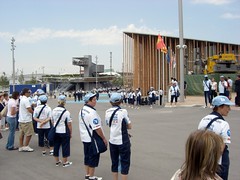
It was the Spain National Day of Honor at the site, so the Spanish Pavilion was closed. Presumably this was because of dignitaries. The site is certainly not lacking for volunteers in their iconic outfits.
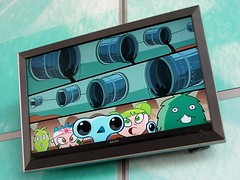
Fans of Expo 2005's Kiccoro and Morizzo will be happy to see them teamed up with Expo 2008's Fluvi outside the Japan Pavilion.
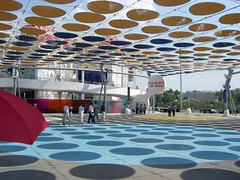
The themed areas were connected with this wonderful sunshade that seemed to visually pull together the disparate pavilions. There were plenty of nice benches, too. However, it would have been nice if they'd put the benches under the shade.
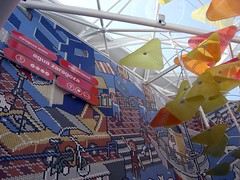
The Cities of Water Pavilion proves that you don't necessarily need new technology to create an effective exhibit. I'll speak later of the Water theme, but this pavilion exposed some of the problems with water as a theme. The issues are far more complex than can really be dealt in pavilions such as this and some of the inconsistencies are mostly unaddressed. Dams can convert water into power lessening our dependence on oil, but it can create other environmental problems.

Ten years ago at Lisbon's Expo 98, I noticed that many pavilions were using class floors so that you seemingly hovered over sand, water, or other materials. It seems like a common design choice this year is a white plastic flooring that I would imagine holds up to traffic pretty well and is certainly different from what you see in everyday life. Here's how it looked at the Sweden Pavilion. Carpet is harder to photograph than you might imagine.
...and now I'm off to Day 4!
I tried to visit the theme structure, the Water Tower (or Tower of Water), but unfortunately, it was closed for some reason. Unfortunately, my Spanish and the volunteers' English wasn't good enough to find out why. They suggested I try back later on. The tower was particularly striking at sunset, however.
To my eyes, though, I would have liked to have seen something a bit more iconic. The tower, from the outside at least, looks too much like many office towers I've seen.
Galicia's pavilion was a good example of a small, simple pavilion that really works. There wasn't much to their exhibit as it was one where people simply wandered in and out, but the video installation was striking enough that I noticed many guests lingered for quite a while. It was more artistic and abstract that a simple video screen. Upon further inspection, I discovered each colored rectangle was actually the bottom of a plastic food dish filled with water and with red, green, and blue LED's inside. I took some more photos as well as video of this exhibit which I'll be posting later.
It was the Spain National Day of Honor at the site, so the Spanish Pavilion was closed. Presumably this was because of dignitaries. The site is certainly not lacking for volunteers in their iconic outfits.
Fans of Expo 2005's Kiccoro and Morizzo will be happy to see them teamed up with Expo 2008's Fluvi outside the Japan Pavilion.
The themed areas were connected with this wonderful sunshade that seemed to visually pull together the disparate pavilions. There were plenty of nice benches, too. However, it would have been nice if they'd put the benches under the shade.
The Cities of Water Pavilion proves that you don't necessarily need new technology to create an effective exhibit. I'll speak later of the Water theme, but this pavilion exposed some of the problems with water as a theme. The issues are far more complex than can really be dealt in pavilions such as this and some of the inconsistencies are mostly unaddressed. Dams can convert water into power lessening our dependence on oil, but it can create other environmental problems.
Ten years ago at Lisbon's Expo 98, I noticed that many pavilions were using class floors so that you seemingly hovered over sand, water, or other materials. It seems like a common design choice this year is a white plastic flooring that I would imagine holds up to traffic pretty well and is certainly different from what you see in everyday life. Here's how it looked at the Sweden Pavilion. Carpet is harder to photograph than you might imagine.
...and now I'm off to Day 4!
24 June 2008
Expo 2008, Day 2
During day two of my visit, I mostly concentrated on seeing more of the national pavilions. Germany, not surprisingly, was a highlight.
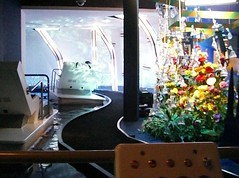
Germany's pavilion features a dark ride with recliner seats on boats. Unlike other dark rides I've been on, the intended visual focus is the ceiling. It's a very unique ride and a sometimes whimsical take on the expo's water theme.
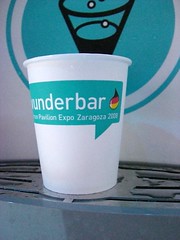
They even had free water at the end. After seeing exhibit after exhibit about water in Zargoza's 90º F heat, you can imagine how thirsty you get.
It surprises me that no other pavilion I've visited thus far has done this. Wunderbar!
Belgium recognizes the 50th anniversary of Expo 58 with models of the Atomium as well as this book in their gift shop.
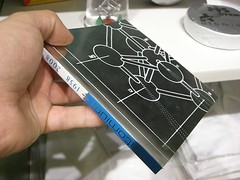
I wanted to buy one of the books, but was told they didn't know how much to charge and I should come back next week when they know.
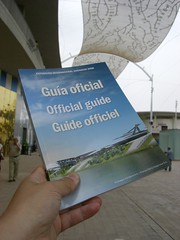
On a better note, I discovered where to buy the official guidebook. At most expositions, the guidebooks are front and center in the gift shops. At Expo 2008, they only seem to sell the book at off-site newsstands and bookshops and their rather well-stocked on-site bookshop. I was pleased to see they have all manner of books related to the issues of water and sustainable development.
Germany's pavilion features a dark ride with recliner seats on boats. Unlike other dark rides I've been on, the intended visual focus is the ceiling. It's a very unique ride and a sometimes whimsical take on the expo's water theme.
They even had free water at the end. After seeing exhibit after exhibit about water in Zargoza's 90º F heat, you can imagine how thirsty you get.
It surprises me that no other pavilion I've visited thus far has done this. Wunderbar!
Belgium recognizes the 50th anniversary of Expo 58 with models of the Atomium as well as this book in their gift shop.
I wanted to buy one of the books, but was told they didn't know how much to charge and I should come back next week when they know.
On a better note, I discovered where to buy the official guidebook. At most expositions, the guidebooks are front and center in the gift shops. At Expo 2008, they only seem to sell the book at off-site newsstands and bookshops and their rather well-stocked on-site bookshop. I was pleased to see they have all manner of books related to the issues of water and sustainable development.
22 June 2008
Expo 2008, Day 1
Today was the first day of my six day visit to Zaragoza, Spain's Expo 2008.
I am posting photos of my visit to ExpoMuseum's Expo 2008 Photos Page as I go along.
Today's highlights included a wonderful presentation at the Andalusia film that mixes video, lasers, and water to give a great sense of the region. This pavilion also demonstrates one of the things I most appreciate about good pavilion design in that it incorporates real people into the presentation. It makes it far more personal and compelling.
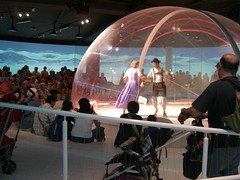
Austria also has a delightful pavilion that plays on the same humanistic theme. After proceeding up a ramp, you enter into a theater with a large inflated snow globe. It's actually only 1/4th of a globe reflected against a long mirrored wall. Inside the globe are fans and fake snow to give the illusion of a snow globe. A guest is selected by the pavilion staff as people are being seated. Moments later, the guest appears in the globe with a companion dancer dressed in traditional Austrian clothes. They dance a waltz for the audience. It was wonderful to watch the audience react.
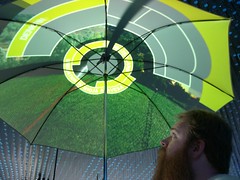
The Basque region of Spain used an interesting bit of technology where guests grasped suspended umbrellas with video displays projected on them. The handle of the umbrellas controls the images.
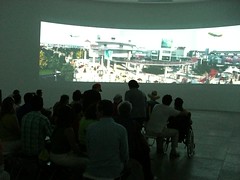
Not surprisingly, China's pavilion had on display its plans for Expo 2010.
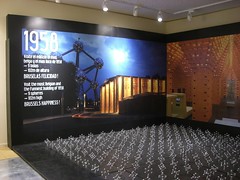
The Belgium pavilion, conversely, looked back 50 years to its own Expo 58.
I am posting photos of my visit to ExpoMuseum's Expo 2008 Photos Page as I go along.
Today's highlights included a wonderful presentation at the Andalusia film that mixes video, lasers, and water to give a great sense of the region. This pavilion also demonstrates one of the things I most appreciate about good pavilion design in that it incorporates real people into the presentation. It makes it far more personal and compelling.
Austria also has a delightful pavilion that plays on the same humanistic theme. After proceeding up a ramp, you enter into a theater with a large inflated snow globe. It's actually only 1/4th of a globe reflected against a long mirrored wall. Inside the globe are fans and fake snow to give the illusion of a snow globe. A guest is selected by the pavilion staff as people are being seated. Moments later, the guest appears in the globe with a companion dancer dressed in traditional Austrian clothes. They dance a waltz for the audience. It was wonderful to watch the audience react.
The Basque region of Spain used an interesting bit of technology where guests grasped suspended umbrellas with video displays projected on them. The handle of the umbrellas controls the images.
Not surprisingly, China's pavilion had on display its plans for Expo 2010.
The Belgium pavilion, conversely, looked back 50 years to its own Expo 58.
10 June 2008
Expo 2008 Opens in 4 Days
With Expo 2008's opening ceremonies just days away, things have clearly been busy in Zaragoza. Given Expo 2008's theme of water and sustainable development, it was ironic that the River Ebro flooded. From some of the photos I've seen posted on Flickr.com, it looks like it put some of the amphitheater underwater.
Last weekend, they had a test run with some folks on site and waiting in lines. I've found several videos on YouTube showing the sites, particularly the amazing views from the gondalas/telecabinas that run from Zaragoza's main railway station to the site.
Here's a representative video:
I leave for Europe this weekend and arrive in Zaragoza on the 21st. I'll be there a week and hope to have enough time to see everything, take tons of photos, and get some audio for ExpoMuseum's upcoming podcast.
Last weekend, they had a test run with some folks on site and waiting in lines. I've found several videos on YouTube showing the sites, particularly the amazing views from the gondalas/telecabinas that run from Zaragoza's main railway station to the site.
Here's a representative video:
I leave for Europe this weekend and arrive in Zaragoza on the 21st. I'll be there a week and hope to have enough time to see everything, take tons of photos, and get some audio for ExpoMuseum's upcoming podcast.
17 December 2007
Expo 2008 Preview
I discovered today a great video previewing the Expo 2008 site and thought I'd share it with readers. Opening day is now less than 6 months away!
15 June 2007
One Year Until Expo 2008
Yesterday marked the "one year to go" mark until Expo 2008. Given the difficulty I've found in past years finding hotels during world's fairs, I'm going to try to start booking a room soon since most hotels don't allow reservations until one year before a date.
Also, I won't be making the mistake I made in 2005 and go the last couple of weeks. It seems that people all over the world share one universal trait: procrastination. If you look at attendance figures of world's fairs, there's always a huge spike right at the end.
Given the new timing of expositions (a big one every five years with a small one in between two big ones... but not in an adjacent year) and given that all three cities bidding for the 2012-2013 slot have chosen 2012, we'll have three expositions in the next five years! We won't have two back-to-back non-expo years until 2013-2014!
It's clear that excitement is building worldwide for expositions. In 2012, we might have our first Polish expo (in Wroclaw) or our first African expo (in Tangier, Morocco). In 2012 or 2015. We could have our first world's fair in an Islamic country in either Tangier (2012) or Izmir, Turkey (2015).
Notably Absent from the list of planned and potential future expos are any in the Western Hemisphere. The last exposition held in the Western Hemisphere was Expo 86 in Vancouver. With the next slot available for bidding being 2017-2018, we'll see at least a 31 year gap in North American world's fairs, very shocking given the strong history of international expositions in the United States particularly.
Let's hope the United States, Canada, or Mexico picks up the torch for 2017, 2018, or 2020
Also, I won't be making the mistake I made in 2005 and go the last couple of weeks. It seems that people all over the world share one universal trait: procrastination. If you look at attendance figures of world's fairs, there's always a huge spike right at the end.
Given the new timing of expositions (a big one every five years with a small one in between two big ones... but not in an adjacent year) and given that all three cities bidding for the 2012-2013 slot have chosen 2012, we'll have three expositions in the next five years! We won't have two back-to-back non-expo years until 2013-2014!
It's clear that excitement is building worldwide for expositions. In 2012, we might have our first Polish expo (in Wroclaw) or our first African expo (in Tangier, Morocco). In 2012 or 2015. We could have our first world's fair in an Islamic country in either Tangier (2012) or Izmir, Turkey (2015).
Notably Absent from the list of planned and potential future expos are any in the Western Hemisphere. The last exposition held in the Western Hemisphere was Expo 86 in Vancouver. With the next slot available for bidding being 2017-2018, we'll see at least a 31 year gap in North American world's fairs, very shocking given the strong history of international expositions in the United States particularly.
Let's hope the United States, Canada, or Mexico picks up the torch for 2017, 2018, or 2020
25 May 2007
Digital Water Pavilion at Expo 2008, Zaragoza
Back in 1996, I went back to my hometown of Atlanta for the Olympics. In the Olympic Village, I remember seeing a display of a digital waterfall. Water flowed from a series of computer-controlled nozzles. Most of the messages were text, but it was a great display, particularly since everything falls at different rates at different times, so the text would stretch out before hitting the pool underneath.
It looks like Expo 2008 will extend the concept farther and have an entire Digital Water Pavilion with walls made of falling water.
I can't wait to see it in person!
This post violates two of my self-imposed rules: Two posts back-to-back about the same exposition and two posts back-to-back of YouTube video. But hey, I couldn't pass up sharing this.
It looks like Expo 2008 will extend the concept farther and have an entire Digital Water Pavilion with walls made of falling water.
I can't wait to see it in person!
This post violates two of my self-imposed rules: Two posts back-to-back about the same exposition and two posts back-to-back of YouTube video. But hey, I couldn't pass up sharing this.
Subscribe to:
Comments (Atom)